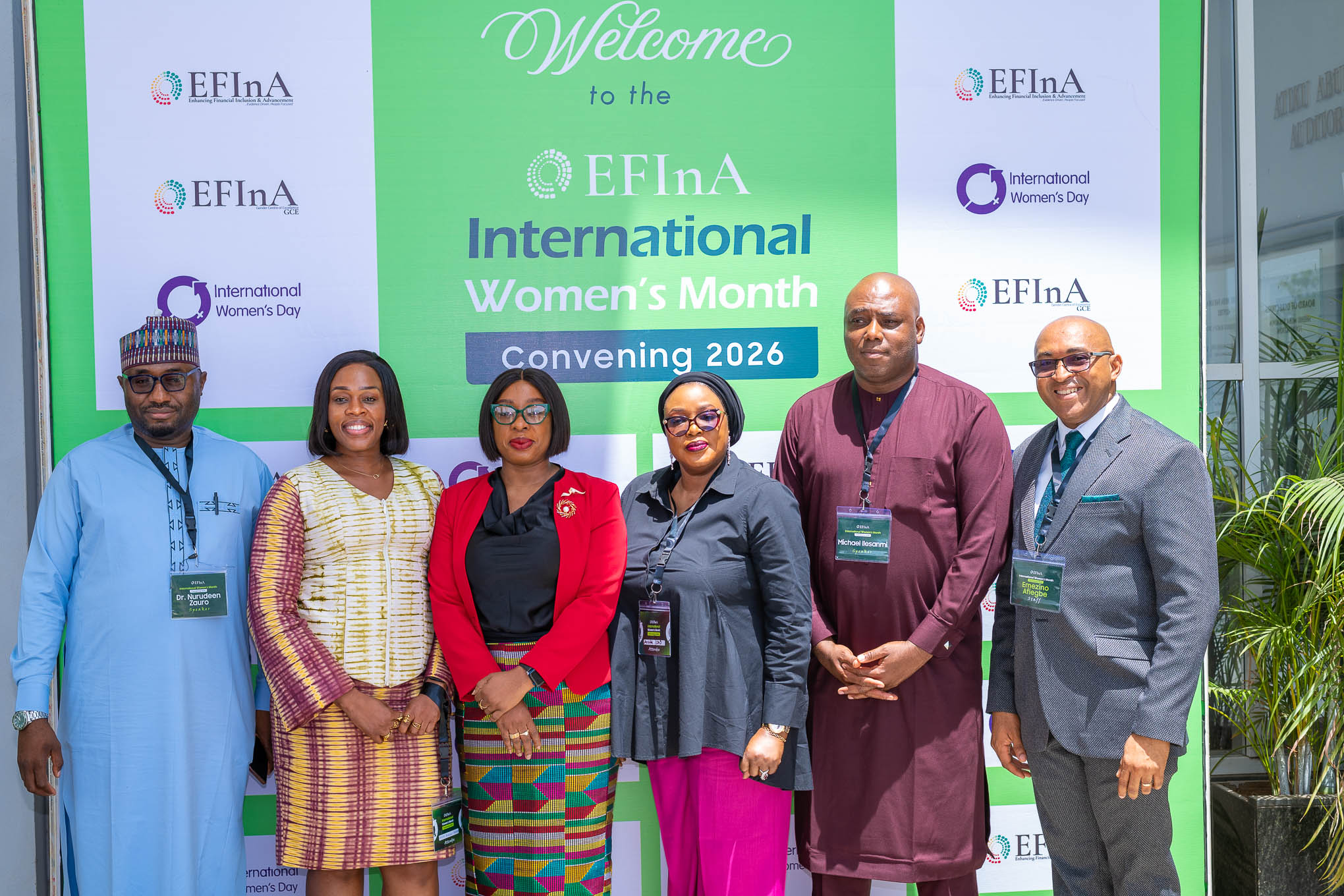


Lagos, Nigeria — Enhancing Financial Inclusion and Advancement (EFInA), through its Gender Centre of Excellence (GCE), is advancing gender mainstreaming as a strategic approach to strengthening financial institutions’ portfolios while accelerating women’s financial inclusion and economic empowerment in Nigeria.
The initiative, themed “Gender Mainstreaming to Advance Sustainable Portfolio Growth,” brings together select Financial Service Providers (FSPs) in an interactive capacity-building workshop designed to move institutions from intention to implementation. The programme supports financial institutions to embed a gender lens across product design, credit processes, customer engagement, and internal decision-making, with a particular focus on women customers.
While Nigeria has recorded steady progress in reducing overall financial exclusion, evidence shows that the gender gap has widened. Women remain disproportionately excluded from formal financial services, especially credit, despite representing approximately half of Nigeria’s adult population and a significant share of nMSME (nano, micro, small and medium enterprises) owners. This persistent gap underscores the need for more deliberate, data-driven, and institution-wide approaches to gender inclusion.

Speaking on the rationale behind the initiative, Emezino Afiegbe, Lead, Gender Centre of Excellence, noted that the programme is deliberately framed around both impact and value: “This programme is designed to support financial institutions in clearly seeing the opportunity, impact, and commercial value of applying a gender lens to how they design products, processes, and services.”
EFInA’s Access to Financial Services in Nigeria (A2F) 2023 Survey highlights that approximately 21 million adult women in Nigeria remain excluded or underserved by formal financial services. Many of these women are economically active, operating nano, micro and small enterprises, managing household finances, and participating in informal savings and credit arrangements, yet remain invisible to formal financial systems.
Structural barriers such as limited asset ownership, informal income streams, and restrictive social norms are often compounded by institutional practices that unintentionally disadvantage women. These include rigid credit scoring models, collateral-heavy underwriting requirements, and product designs that fail to reflect women’s cash-flow realities and risk profiles.

Through this initiative, EFInA is supporting financial institutions to better understand women’s lived contexts and to redesign internal systems in ways that are both inclusive and commercially sound. “By strengthening institutional understanding of women’s financial realities, we are building practical capacity to serve excluded and underserved women, an addressable market of about 21 million adults in Nigeria,” Afiegbe added.
As part of the rollout of the initiative, the Gender Centre of Excellence has partnered with leading financial institutions, including First City Monument Bank (FCMB), Ecobank and Parallex Bank, to deliver the immersive workshop within their organisations. The programme is targeted at a carefully selected cohort per institution, drawn from business-critical functions that directly influence women’s access to, and productive use of, credit. By convening cross-functional decision-makers and implementers, the initiative ensures that gender mainstreaming is embedded across institutional strategy, operations, and delivery channels.
The workshop also adopts a practical, hands-on approach, guiding participants through key thematic modules that address the full customer and credit lifecycle. Participants are also exposed to data and strategy tools such as EFInA’s Women’s Economic Empowerment Dashboard, which provides actionable insights to guide product development, segmentation, and performance tracking.
As EFInA continues to work with financial institutions, regulators, and ecosystem partners, this initiative is expected to contribute to stronger household resilience, enterprise growth, job creation, and broader economic productivity, advancing both institutional performance and national development goals.